
Preparing for a CVS Data Engineer interview means knowing what the role actually demands. CVS works with large amounts of pharmacy, insurance, and patient data every day, so they look for engineers who can move, clean, and secure data with accuracy and care. Strong SQL, cloud experience, modern data pipeline skills, and knowledge of healthcare data rules are core requirements.
Interviewers also want to see how well you communicate, solve real data issues, and collaborate with analytics and product teams. Expect a mix of technical questions, hands-on tasks, and behavioral scenarios. This guide highlights exactly what CVS looks for and the questions that commonly come up, helping you prepare with focus and confidence.
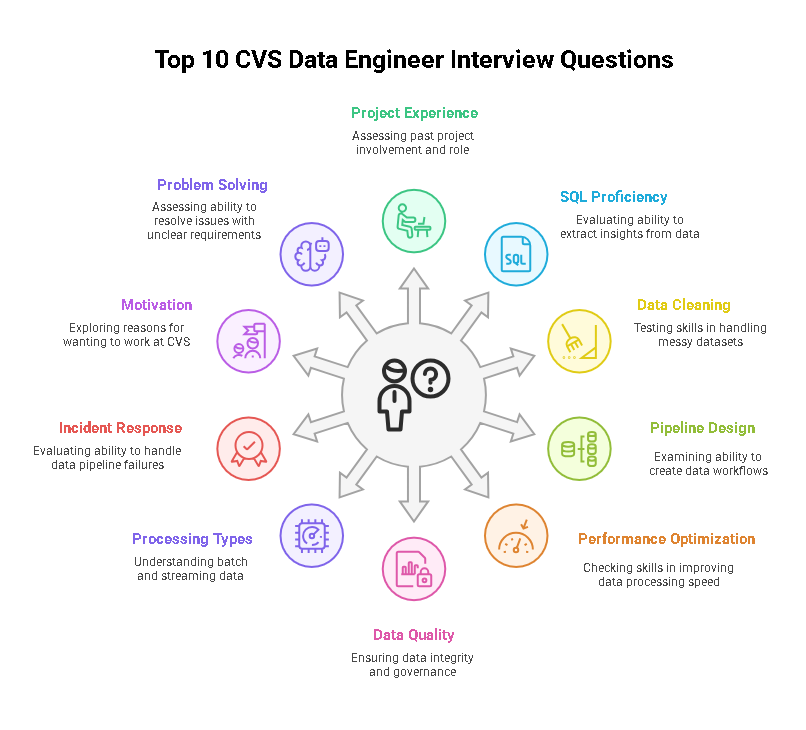
Top 10 CVS Data Engineer Interview Questions
With its vast healthcare data and complex infrastructure, CVS Health offers a challenging yet rewarding environment for data engineers. Whether you’re preparing for your first tech interview or targeting a mid-to-senior role, it’s essential to know what kinds of questions to expect. From SQL to data pipeline design, expect a blend of technical depth and business-oriented problem-solving.
To help you get ready, here are the Top 10 Data Engineer Interview Questions commonly asked at CVS — along with the key skills they test.
1️⃣ Walk us through a recent data engineering project you worked on. What was the goal, and what was your specific role?
Interviewers ask this question to see if you can explain real work clearly and show that you understand why the project mattered. They want to learn how you think, how you build solutions, and how well you work with others. Your answer should show that you can take a business problem, turn it into a data problem, and deliver something useful. It also proves you can handle real deadlines, messy data, and constant changes.
A good answer is short and focused on one project. Explain the goal first, so they know the purpose behind your work. Then explain what you built, how you made decisions, and the challenges you solved. Most candidates talk only about tools, but interviewers care more about results. When you share the outcome—like faster reporting, fewer errors, or lower cost—it shows that what you built made a difference. That’s what they remember.
Finally, include one quick lesson learned. It shows you improve every time you build something new. This question gives you a chance to shine, because it connects your experience with the value you can bring to CVS. Keep it simple, confident, and meaningful.
2️⃣ Write a SQL query to extract useful business insights from a pharmacy-related dataset. Explain your logic.
For this question, CVS wants to see if you can turn a vague business need into a clear SQL solution. In real work, no one hands you a perfect spec. Someone might say, “We need to know which drugs are underperforming,” or “Which stores are missing refills?” Your job is to imagine the tables, think through the logic, and write a query that gives a useful answer.
A strong response starts by clarifying the goal in plain English. For example, you might say you’d look at prescription fills by store and date, then compare them against targets. From there, walk through your steps: which tables you would join, what filters you’d apply, how you’d group the data, and what metrics you’d return. While you talk, keep the structure simple—clean joins, clear conditions, and readable column names. That makes you look like someone others can work with.
What really stands out is when you show that you care about both correctness and speed. You might mention adding filters early to reduce data, using proper keys for joins, or thinking about indexes on common filter columns. Even one quick comment about performance separates you from people who only think about “does it run?” This question is your chance to prove that you can help CVS answer real pharmacy questions with clear, efficient SQL, not just pass coding tests.
3️⃣ How would you clean and transform a messy dataset using Python or Pandas?
Messy data is normal at a company like CVS, so this question checks whether you can bring order to chaos without breaking things. They’re testing how you think step by step: do you jump straight into code, or do you first ask, “What does ‘clean’ mean for this dataset and this use case?” A strong answer starts with understanding the target output (for example, a report, a feature table, or a model input), then works backward to decide which columns matter, what bad records look like, and what you’ll do with them.
Instead of listing every Pandas function you know, walk them through a clear process: inspect the data, spot missing values and strange outliers, standardize formats like dates and IDs, fix or drop duplicates, and create any new fields the business needs. Sprinkle in a few concrete moves like dropna vs filling values, using groupby for aggregations, or applying custom functions for awkward business rules. It also helps to mention that you keep transformations repeatable, usually with a reusable script or notebook, so the same cleaning logic can run daily or hourly. This tells CVS you can handle real, ugly tables and still produce reliable datasets that analytics and downstream pipelines can trust.
4️⃣ Design an end-to-end data pipeline for a CVS use case (such as prescription analytics or refill reminders). Which tools and steps would you choose?
Here, the interviewer is looking for your “systems thinking” more than a perfect diagram. You’re being judged on how you break a CVS-style problem—like daily prescription analytics or refill reminders—into clear stages: data sources, ingestion, storage, transformation, serving, and monitoring. A strong answer starts with a quick use case in simple terms (“We want to send refill reminders based on recent prescription activity”), then walks through how data flows from source systems into the pipeline. You might mention pulling data from pharmacy systems or claims feeds, landing it in cloud storage, processing it with Spark or Databricks, and loading the results into a warehouse like BigQuery or Synapse.
Tool choices matter, but only if you connect them to reasons: batch jobs for daily summaries, streaming if reminders should be near real time, orchestration with Airflow for scheduling and dependencies, and a warehouse or feature store so analysts and applications can actually use the output. It helps to mention basics like logging, alerts, and data quality checks along the way, plus safeguards for sensitive health data. What separates a strong candidate is the ability to keep this explanation clear and grounded in a CVS context—showing you can design something that works for patients, business users, and the engineers who will maintain it after you.
5️⃣ How do you improve the performance of a slow SQL query or a long-running Spark job?
This question tells the interviewer how you think under pressure, because slow queries and heavy Spark jobs hit real deadlines and cloud bills. They want to see that you don’t just guess and hope, but follow a simple, repeatable process. A good way to answer is to say you first confirm the problem (what “slow” means, how often it runs, who it affects), then look at the execution plan or job UI instead of changing random parts of the code. That shows you use facts, not guesswork.
For SQL, you can talk about checking unnecessary SELECT *, removing pointless subqueries, fixing bad joins, adding or adjusting indexes on key filter and join columns, and reducing the data early with filters or pre-aggregations. For Spark, you might mention correcting skewed joins, using broadcast joins when one side is small, choosing sensible partitions, caching only what’s reused, and setting cluster size based on data volume instead of just “bigger is better.” If you also say you measure before and after—runtime, cost, or resource use—you prove you care about impact, not just code style. That’s exactly what a team at CVS wants: someone who can keep data jobs fast, reliable, and affordable while still delivering the same business result.
6️⃣ How do you maintain data quality and governance when working with healthcare datasets?
Here, CVS wants to know if you can protect patient trust while keeping data accurate enough for decisions. Healthcare records come from many systems, and mistakes can impact care, so treating data quality as a daily practice matters more than any tool. A strong answer shows that you think about quality from the moment data enters the pipeline. You validate formats like IDs and dates, check for missing or duplicate records, and handle strange values instead of ignoring them. You also build these checks into the pipeline so issues are spotted early, not after a dashboard is wrong.
Governance is the other half. You keep track of where each field comes from, who has access to it, and how it’s allowed to be used. You mention role-based access, masking sensitive fields, and logging changes so nothing is hidden. Healthcare data needs extra protection, so showing awareness of privacy rules—even in simple language—helps you stand out. If you add that you communicate data standards with analysts and others who rely on the data, you show you’re not just cleaning in silence. This question gives you a chance to prove you understand the responsibility that comes with handling information that affects real patients.
7️⃣ What are the key differences between batch and streaming processing, and where would each apply at CVS?
CVS asks this to see if you can pick the right solution instead of treating every problem the same. Batch processing works well when data doesn’t need instant action. For example, daily reports on prescription sales or insurance claims can run in scheduled jobs. You collect the data, process it all at once, and deliver results that help teams plan inventory or review performance.
Streaming is different. It focuses on reacting fast. Think of a system that watches refill activity in near real time and alerts customers before they run out. Data arrives continuously, and decisions happen as events happen. That can improve service and help prevent gaps in care.
A strong answer explains the difference in simple terms: batch is like reading yesterday’s news, streaming is like watching it live. Then connect each method to a specific CVS use case. That shows you understand both the technology and how CVS serves patients.
8️⃣ How would you respond if a data pipeline fails right before an important report or deadline?
A pipeline failure at the wrong moment forces quick choices. Instead of rushing blindly, the smart move is to pause just long enough to understand the situation: what broke, what data is missing, and who will feel the impact first. Then you take the lead and let stakeholders know what’s happening so there are no surprises while you fix the issue.
Next, you focus on recovery, not perfection. You find the simplest way to restore the data the business needs most. That might mean rerunning only the failed step, skipping a non-critical transformation, or delivering partial results if that keeps operations moving. After the deadline is protected, you can address the remaining work without pressure.
Finally, once everything is running again, you record what failed and update checks, alerts, or fallback steps to avoid a repeat. This shows you can protect timelines, communicate clearly, and improve the system after every issue. That’s exactly how CVS expects a Data Engineer to respond when real-world problems show up at the worst time.
9️⃣ Why do you want to work as a Data Engineer at CVS Health?
This question checks whether you’ve done your homework and if you care about the mission behind the work. CVS Health isn’t just processing transactions; it’s supporting patient care at pharmacy counters, clinics, and insurance services nationwide. A good answer connects your skills to that purpose. You might explain that you enjoy building data systems that help people make better health decisions, reduce delays in care, or improve medication access. That shows you understand the impact behind the job.
It also helps to mention why the scale of CVS motivates you—massive data volume, many different sources, and a chance to build pipelines that must be fast, accurate, and safe for millions of patients. You can talk about how teamwork with analysts and clinical partners excites you, because the insights from your pipelines go straight into real improvements in service.
By expressing interest in both the technical challenge and the patient-focused outcomes, you show you’re choosing CVS with intention, not just applying everywhere. That’s the message interviewers want to hear.
🔟 Tell us about a time unclear requirements caused delays or issues. How did you resolve the situation?
Teams at CVS work with many stakeholders who may not speak the same technical language, so this question checks whether you can turn vague requests into something that actually gets built. The interviewer wants to see patience, communication, and problem-solving — not frustration or blame. The best way to answer is to show how you slowed things down just enough to ask smart questions and confirm what success should look like.
A simple approach is to describe a situation where you noticed confusion early, set up a short meeting to clarify expectations, and turn fuzzy goals into a clear plan. Then explain how you shared examples, sketches, or sample output to get fast feedback and avoid further delays. You can mention that once everyone agreed, the work moved faster and the final result matched what users truly needed.
This question is your chance to show maturity — you don’t assume, you verify. You work with people outside engineering without making them feel wrong. That’s a skill CVS values because clean communication saves time, protects patient-focused projects, and helps the whole team succeed.
Conclusion
Interviewing for a CVS Data Engineer role means proving you can handle real data problems that affect real people. These 10 questions reflect what matters most to the company: strong technical skills, clear communication, smart decision-making, and a genuine interest in improving healthcare. If you focus on explaining your thinking, connecting your work to business outcomes, and showing how you learn from experience, you’ll stand out from other candidates. Use this guide as a checklist and practice confidently — you’ll be ready to show CVS that you can keep data accurate, secure, and useful at a scale that truly makes a difference.